

Master your cellular energy production for peak performance, vitality, and longevity, Start the 11-part series below.
The brain is the most energetically demanding organ in the human body, and it is correspondingly sensitive to any reduction in mitochondrial function. Understanding this connection is one of the most important insights in modern neuroscience and mitochondrial biology.
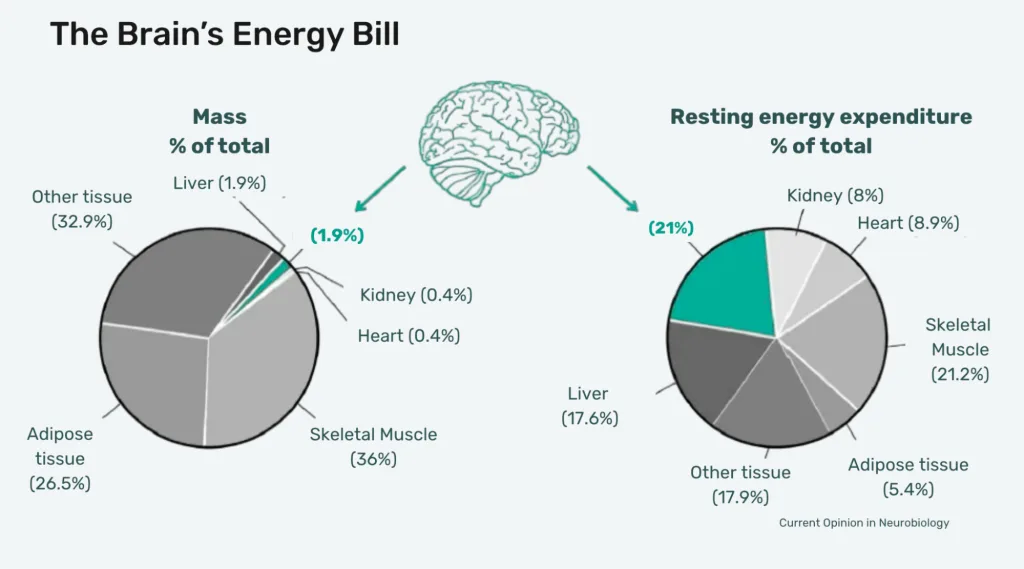
Your brain represents approximately 2 percent of your total body mass. Yet it consumes roughly 21 percent of the body’s resting energy (see the image below for a comparison of energy expenditure of various organs). Pound for pound, the brain is the most energy-intensive tissue in the body. It never fully rests. Even during sleep, particularly during the REM phase of sleep, it consumes more energy than many organs do during active function, as it processes information, consolidates memories, and performs essential maintenance.
Mitochondria support brain function through several interconnected mechanisms:
ATP production for neural signaling. Every nerve impulse, every synaptic transmission, and every molecular process involved in thought requires ATP. The synthesis of neurotransmitters, the maintenance of ion gradients across neuronal membranes, and the active transport of molecules within neurons all depend on a continuous supply of mitochondrial energy.
Calcium buffering. Calcium plays a central role in synaptic function. Mitochondria in neurons act as buffers, absorbing and releasing calcium to regulate the signaling that underlies learning and memory. Disruptions in mitochondrial calcium handling impair synaptic plasticity, the cellular basis of learning.
Regulation of neuronal survival. Mitochondria coordinate the processes of apoptosis (programmed cell death) and neuroprotection. Healthy mitochondria maintain the balance that keeps neurons alive and functional. Dysfunctional mitochondria shift this balance in ways that contribute to neuronal death.
Supporting synaptic plasticity. The structural changes in synapses that underlie learning and memory are energetically expensive. Adequate mitochondrial function is required to support the protein synthesis and structural remodeling involved in forming new neural connections.
Psychobiological integration. Research by Martin Picard and colleagues has established that mitochondria connect the energetics of the body with the function of the brain, translating social and psychological experiences into biological signals. This means that mitochondrial health influences not only how the brain functions mechanically but how it processes and responds to experience.
Brain fog. The feeling of mental heaviness, difficulty concentrating, slow processing, and impaired word retrieval that many people call brain fog corresponds closely to the energy deficit produced by reduced mitochondrial output in the brain. The brain is trying to run on less power than it needs.
Memory impairment. Encoding new memories and accessing stored ones both require substantial energy. Declining mitochondrial function in the hippocampus and associated regions impairs both processes, contributing to the memory changes commonly associated with aging.
Processing speed. The speed at which the brain processes information is directly related to how efficiently its neurons are functioning. Reduced mitochondrial energy output slows neuronal signaling, reducing processing speed in ways that affect response time, decision-making, and complex reasoning.
Mood and emotional regulation. Mitochondria are active in the brain regions that regulate emotion, stress response, and mood. Disruptions in mitochondrial function in these areas can contribute to heightened stress reactivity, anxiety, and depressive symptoms. The connection between mitochondrial health and mental health is an active area of research, with evidence mounting that cellular energy deficits in the brain contribute meaningfully to mood disorders.
The decade-by-decade decline in mitochondrial density that begins around age 21 is particularly consequential for the brain. Neurons are largely post-mitotic, meaning they do not regenerate in the way that other cell types do. The neurons a person has are largely the ones they will have throughout life, making the maintenance of those cells’ mitochondrial function critically important for long-term cognitive health.
As mitochondrial function in neurons declines with age, the brain’s energy reserve capacity decreases. Cognitive tasks that were once easy require more effort. Recovery from mental stress takes longer. The brain becomes more vulnerable to the energy deficits produced by poor sleep, illness, or physical stress.
In more advanced cases, mitochondrial dysfunction in the brain is implicated in neurodegenerative conditions including Alzheimer’s disease, Parkinson’s disease, and frontal lobe dementia. The common thread across these conditions is neuronal energy deficit and mitochondrial impairment.
The strategies that support mitochondrial health generally are particularly relevant for brain health:
Exercise increases cerebral blood flow and stimulates mitochondrial biogenesis in brain tissue, improving the brain’s energy supply and its resilience to stress.
Sleep is when the brain performs its most intensive maintenance, clearing metabolic waste, consolidating memories, and allowing mitochondrial repair and renewal to occur. Chronic sleep deprivation is one of the most reliably damaging things for brain mitochondrial health.
Nutritional quality affects the fuel and micronutrients available to brain mitochondria. Antioxidant-rich foods help manage the oxidative burden that brain mitochondria are constantly managing. Ultra-processed foods and excess fructose add to that burden.
Stress management matters because chronic psychological stress activates the Cell Danger Response in brain cells, altering mitochondrial function and reducing the energy available for normal cognitive operations.
Targeted molecular support with compounds that stimulate mitochondrial biogenesis in neural tissue may help maintain the density and function of the mitochondrial population in brain cells over time.
The capacity to think clearly, remember accurately, and respond with emotional balance all trace back, in part, to the health of the mitochondria powering your neurons.
Mitochondrial health is a rich, interconnected field. The pages in this knowledge hub explore each dimension in greater depth, from the molecular mechanics of biogenesis and mitophagy to the relationship between mitochondria and specific health conditions.
This content is for educational purposes only and is not medical advice. Consult a healthcare professional for guidance specific to your situation.
Studies, articles and talks behind this page.
Lustig, Robert. “Welcome and the New Energy Crisis.” BlueOakNx. YouTube video.
Dugar, Sundeep, and Robert Lustig. “Mitochondria & Mental Health: The Energy Crisis in Your Brain.” BlueOakNx. YouTube video.
Dugar, Sundeep. “Why a Mito Cocktail Might Not Be Enough for Autism, PANS/PANDAS.” DocumentingHope. Webinar.
BlueOakNx. “Understanding the Energy Demand of the Developing Brain.” BlueOakNx Blog.
BlueOakNx. “Mitochondria, Energy, and the Brain: Notes from Take Back My Brain.” BlueOakNx Blog. Watch
BlueOakNx. “Metabolism, Mitochondria, and Mental Health: Sundeep Dugar, PhD, Featured on the MindHealth360 Podcast.” BlueOakNx Blog. Listen
Swerdlow, Russell H., and Shaharyar M. Khan. “A ‘Mitochondrial Cascade Hypothesis’ for Sporadic Alzheimer’s Disease.” Medical Hypotheses 63, no. 1 (2004): 8–20. https://doi.org/10.1016/j.mehy.2003.12.045.
Picard, Martin, and Bruce S. McEwen. “Psychological Stress and Mitochondria: A Systematic Review.” Psychosomatic Medicine 80, no. 2 (2018): 141–53. https://doi.org/10.1097/PSY.0000000000000545. Free full text
Naviaux, Robert K., Jane C. Naviaux, Kefeng Li, A. Taylor Bright, William A. Alaynick, Lin Wang, Asha Baxter, Neil Nathan, Wayne Anderson, and Eric Gordon. “Metabolic Features of Chronic Fatigue Syndrome.” Proceedings of the National Academy of Sciences 113, no. 37 (2016): E5472–80. https://doi.org/10.1073/pnas.1607571113.
Naviaux, Robert K., Brooke Curtis, Kefeng Li, Jane C. Naviaux, A. Taylor Bright, et al. “Low-Dose Suramin in Autism Spectrum Disorder: A Small, Phase I/II, Randomized Clinical Trial.” Annals of Clinical and Translational Neurology 4, no. 7 (2017): 491–505. https://doi.org/10.1002/acn3.424. Free full text
Fang, Evandro F., Yujun Hou, Konstantinos Palikaras, Bryan A. Adriaanse, Jesse S. Kerr, Beimeng Yang, Sofie Lautrup, et al. “Mitophagy Inhibits Amyloid-β and Tau Pathology and Reverses Cognitive Deficits in Models of Alzheimer’s Disease.” Nature Neuroscience 22, no. 3 (2019): 401–12. https://doi.org/10.1038/s41593-018-0332-9. Free full text
This content is for educational purposes only and is not medical advice. Consult a healthcare professional for guidance specific to your situation.