

Cell Danger Response & Mitochondria – A Presentation by Dr. Robert Naviaux
At the 2025 BlueOakNx Symposium on Mitochondrial Health, Healthspan and Aging, Robert K. Naviaux, MD, PhD, Professor of Genetics Departments of Medicine, Pediatrics and Pathology, University of California, San Diego School of Medicine, introduced his concept of Cell Danger Response (CDR) in mitochondria and the emerging science of salugenesis
What Medicine Has Missed for 5,000 Years
For 5,000 years the medical industry has taken the pathogenic approach to identifying disease or what makes us sick. Dr. Naviaux refers to the first book of medicine that is filled with conditions, symptoms and treatments in a reductionist framework. He argues that while each area of specialty has solved miraculous states of health, they share a habit that stops short of the holistic goal of interconnected bioenergetics.
Each specialist races to name its one symptom, one diagnosis, one treatment solution without regard to the systemic or underlying healing pathways inherent in all living things, including plants, animals, and humans.
The idea of salugenesis, the science of healing, not disease, is where we need to focus with the same intensity that medicine has studied pathogenic disease.
Watch his presentation here or continue reading below:
Phases of the Cell Danger Response
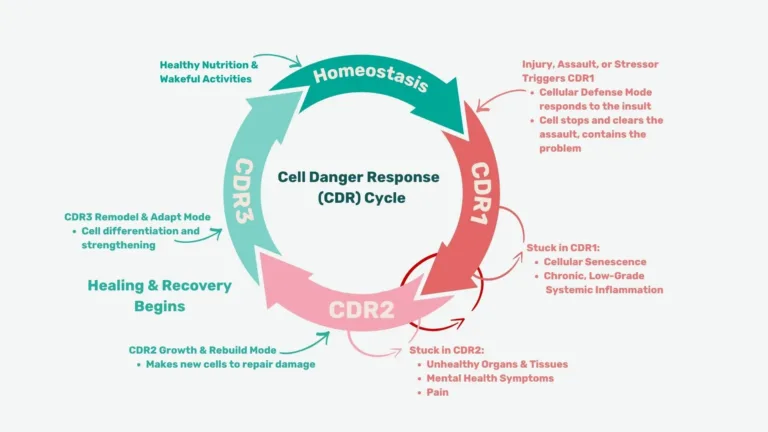
The CDR is the body’s universal biological response to threat. It is governed by over 5,000 genes and over 40 metabolic pathways. It signals danger via ATP and runs in three phases:
- CDR1 is the pro-inflammatory containment phase, where mitochondria shift to glycolysis-dominant metabolism to isolate and contain the threat.
- CDR2 is the proliferative phase, where stem cells divide and aerobic glycolysis replaces cells lost in the acute injury.
- CDR3 is the restorative phase, where anti-inflammatory mitochondria return oxidative phosphorylation and differential function.
The sequence is choreographed: each phase must complete before the next begins.
The following diagram shows the three phases of CDR and the results experienced in each phase.
Cell Danger Response is Driven by ATP
The signal that drives and sustains the CDR is extracellular ATP (eATP). Inside cells, ATP is an energy molecule doing ongoing work of metabolism. When cells release ATP outside their membranes under stress, it becomes something entirely different: a danger signal recognized by every organism on earth.
When eATP remains elevated and cannot be cleared, the CDR cannot progress through its phases. The biological alarm stays on. Chronic Illness Travels in the Blood
The clearest evidence that chronic illness is maintained by a circulating signal rather than permanent tissue damage comes from plasma transfer studies.
When healthy donor cells are exposed to plasma from ME/CFS patients, those cells develop the same mitochondrial pattern as the patients: fragmented organelles, reduced energy output, and the antiviral resistance. Separate experiments showed that healthy red blood cells stiffen when exposed to ME/CFS patient plasma. The disease phenotype travels in the blood. That finding is significant to recovery. If the signal changes, the mitochondria can change with it.
When an individual stops or fails to make progress from an injury or condition, we now know to examine the body’s cellular work capacity, or the bioenergetic threshold required to resolve the CDR.
As noted by Dr. Naviaux, when mitochondria sense a threat, whether from mold, heavy metals, a persistent viral load, or other exposome stressors, they shift from energy production mode to defense mode. This shift protects the cell, but it also results in profound systemic fatigue and halts the healing process.
Identifying and removing the trigger is necessary but not sufficient. Recovery is a highly energy-intensive process, and if the CDR remains active, the cellular energy required to complete the CDR2 and CDR3 may simply not be available. This is the essence of a clinical plateau. When CDR is not resolved chronic disease persists.
To review, acute CDR is normal and necessary for healing. Chronic CDR is abnormal and produces the symptoms of chronic disease.
The Mitochondrial Role: Are They Broken or Following the Wrong Instructions
The concepts of CDR and salugenesis were born out of the practice of mitochondrial medicine. Mitochondria change in response to healing and environmental inputs. They are naturally social organelles that live in a network of interconnected environmental signals. They play roles both internally (housekeeping of cell energy) and externally (danger response) to produce the response to both normal and pathogenic stimulus.
If we injure mitochondria, it blocks the natural response to self-heal or re-establish the mitochondrial network. Incomplete clearing and removal of stressors further damage the adaptation, resulting in a damaged return to the health cycle.
Once the cellular function is reduced, the signals are passed on through the vagus nerve, where 80% of the fibers in the nerve are sensory fibers sending signals to the brain. Dr. Naviaux demonstrates the danger response in microglial cells when triggered by eATP.
Looking again to the similarities to any chronic or broad spectrum condition reveals the power of nature to induce a healing response. What started as mitochondrial research in rare diseases has now been tested in dozens of siloed conditions, such as, autism, ME/CFS, Lyme, muscular dystrophy, and PTSD.
By studying the cause of healing, we find brilliant answers to many states of health. As we have established, a sequence of metabolic events mediated by our mitochondria must happen. Any blockage of this pathway will alter the quality or completion of salugenesis.
What appears as mitochondrial dysfunction is not. They are responding to the signals in the blood and from the brain to do exactly as they are directed to do. For patients who have not been chronically ill for decades, their organelles are not permanently damaged. Their function is being suppressed by signals that can, in principle, change.
How to Support Mitochondrial Health
Supporting mitochondrial health through remedies such as sleep, nutrition, movement, and stress-reduction remains the most evidence-backed way to support the body’s ability to complete the healing cycle.
Dr. Naviaux reminds us of a clear directive that the things that make us the same are far more important than the things that make us different. He invites us to sit with the idea of salugenesis as the medical dark matter of the 21st century: present in over 90% of chronic illness, governing the body’s ability to recover, or stay sick. This is absent from the research agenda that drives modern medicine.
The first book of medicine has saved countless lives. The second book, the science of healing, is still being written.
Read / Listen Next
- Learn more about Salugenesis and the Story of Mitochondria
- Learn more about chronic inflammation and how mitochondrial control it
- Read more about Persistent CDR Creates Blocks in Healing that are Common Roots in Chronic Disease
References
- Naviaux, Robert K. (2020, March). Perspective: Cell danger response Biology—The new science that connects environmental health with mitochondria and the rising tide of chronic illness. Mitochondrion, Vol51. https://www.sciencedirect.com/science/article/pii/S1567724919302922?via%3Dihub
- Naviaux, Robert K. (2022, Dec. 7). Mitochondrial and metabolic features of salugenesis and the healing cycle. The Mitochondrial and Metabolic Disease Center, University of California, San Diego School of Medicine. https://www.sciencedirect.com/science/article/pii/S1567724923000351
- Naviaux, Robert K. (2020, May). The Cell Danger Response: a new paradigm for understanding chronic disease? IHCAN Mitochondrial Medicine. https://aonm.org/wp-content/uploads/2021/07/Cell-Danger-Response-IHCAN.pdf
- Naviaux, Robert K. (2014, May) Metabolic features of the cell danger response. Mitochondrion, e18(2014). https://www.sciencedirect.com/science/article/pii/S1567724913002390?via%3Dihub