


Can Exercise Help in Leigh Syndrome
What if exercise could provide cellular benefits for people with Leigh syndrome who cannot exercise? It sounds like a trick question. But it is the conclusion of more than a decade of mitochondrial research, presented by Sundeep Dugar, PhD, co-founder Blue Oak Nutraceuticals at the 2026 Global Meeting for Leigh Syndrome.
How Mitochondria Produce Energy
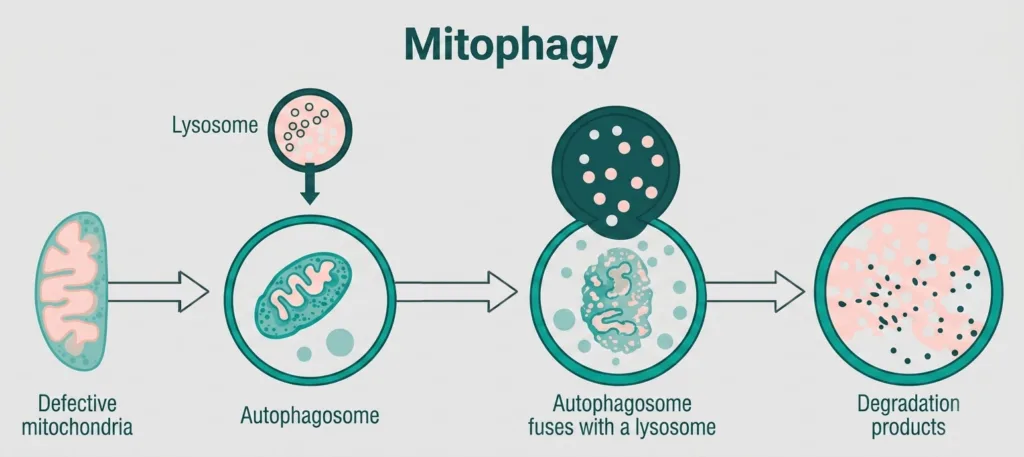
It starts with something that sounds almost impossible. Mitochondria, Dr. Dugar explained, are the only component in your cells that can make more of themselves when needed, fix themselves when broken, and get rid of themselves when not needed. This process is called mitophagy. It is cellular self-management at its finest, all governed by a another process called hormesis.
Mitochondria create ATP through what amounts to a chemical magic trick. They force two negatively charged molecules together, like pushing the south poles of two magnets until they connect. Consider what is actually happening when you have a south pole of a magnet combining with another south pole; there’s inherent repulsion. Mitochondria overcome that repulsion to force two negatively charged molecules together and store massive amounts of energy as ATP.
The numbers are staggering. We have about 100,000 trillion mitochondria in our bodies. A healthy person produces their body weight in ATP every single day. That’s 150 to 160 pounds of energy currency, created fresh daily through chemistry that scientists can’t replicate in a laboratory.
Why Is Exercise Both the Answer and the Problem?
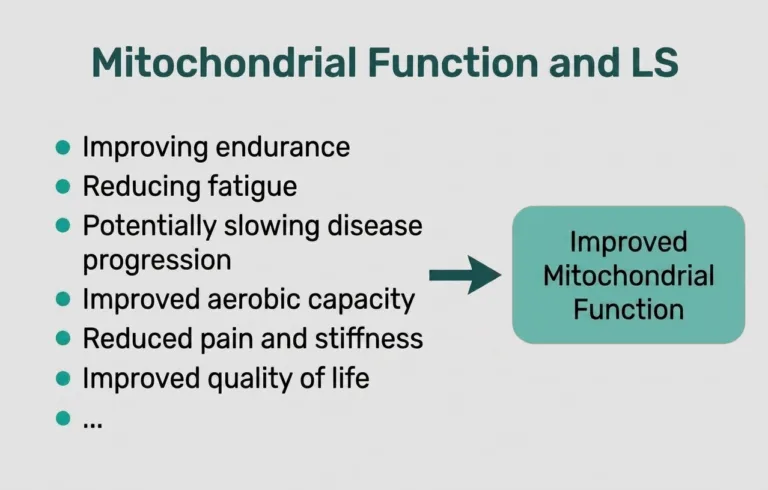
Current treatment approaches being explored, including mitochondrial replacement therapy, gene therapy, and dietary interventions, each address part of the problem. However, one fundamental truth kept surfacing in the research: exercise is the most reliable way we know of improving mitochondrial function, protecting mitochondria from damage, and inducing new mitochondria through biogenesis.
Then came the moment Dr. Dugar’s presentation had been building toward. The catch is built into the disease itself. Exercise intolerance, the inability to sustain meaningful physical exertion, is one of Leigh syndrome’s most consistent symptoms.
The audience could see the paradox clearly. Exercise would help these patients. But they cannot exercise.
What Goes Wrong in Leigh Syndrome?
In Leigh syndrome, this system fails at the genetic level. The presentation showed how mutations in either nuclear DNA or mitochondrial DNA disrupt the electron transport chain, those protein complexes (labeled I through V in Dr.Dugar’s slides) that create the proton gradient necessary for ATP production.
What makes Leigh syndrome so complex is something called heteroplasmy. Unlike typical genetic inheritance where daughter cells match their parents, mitochondrial mutations distribute unevenly. A cell with 40% damaged mitochondria might divide to create one daughter cell with only 20% damage and another with 60%. When that 60% cell divides again, it might produce a cell with 80% dysfunctional mitochondria.
This matters because the cell’s primary defense against accumulating damage is mitophagy, the process by which dysfunctional mitochondria are identified and broken down before they cause further harm. It requires energy to run. And that is exactly what Leigh syndrome depletes.
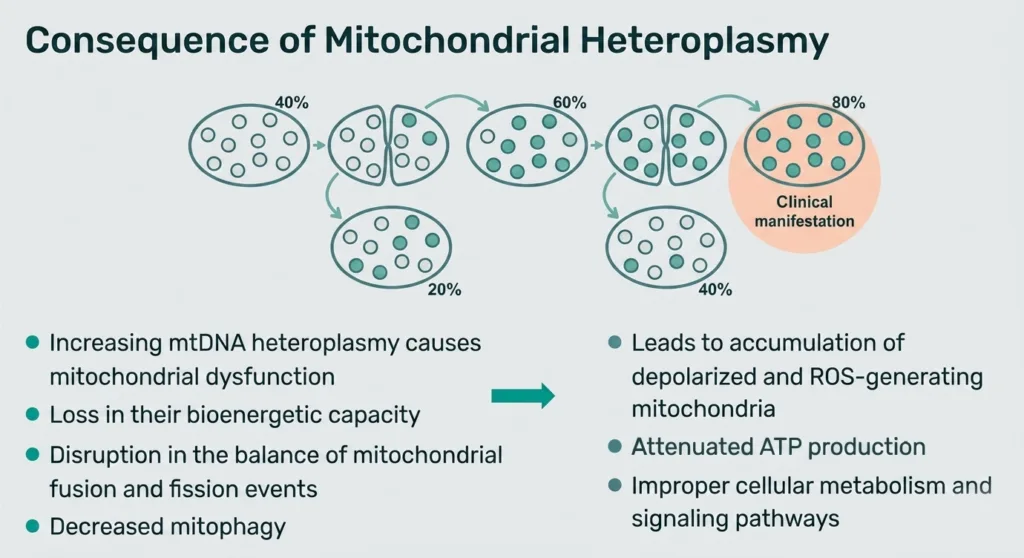
This unequal distribution, shown clearly in Dr. Dugar’s presentation slides, explains why Leigh syndrome affects every patient differently and why symptoms can vary dramatically between tissues in the same individual. The degree of heteroplasmy literally determines the severity of disease.
Why Cells Cannot Clean Up the Damage
Here is the central problem. The accumulation of damaged mitochondria leads to something that is called a competition between cells making more mitochondria and cells losing excessive mitochondria. When damaged mitochondria pile up, they depolarize, generate harmful reactive oxygen species, and produce inadequate ATP.
Clearing out these damaged mitochondria through mitophagy requires energy. ATP. The very thing these damaged mitochondria cannot produce enough of is energy. The cells do not have enough energy to invest in clearing these dysfunctional mitochondria so they accumulate.
What Exercise does at the Molecular Level
This is where years of research paid off. The research team asked a question that reframed the problem entirely: What is exercise actually doing at the molecular level that produces these benefits? The answer was more specific than expected. Researchers identified a novel endogenous hormone that the cell produces when an energy demand is made.
Even more remarkably, they found that (-)-epicatechin (a natural compound found in green tea and cacao), at a precise purity and dosage mimics an endogenous cellular hormone signaling the cell nucleus to increase mitochondrial density and quality, without cell proliferation. For patients who have low energy or limited mobility exercise cannot happen. The signal it sends still can. Just not in the way anyone expected.
Learn more of the science in the full presentation here:
Read / Watch Next
References
- Garate-Carrillo, A., Ramirez-Sanchez, I., Najera, N., Ceballos, G., & Villarreal, F. (2024). (-)-Epicatechin and mitochondrial health: A review of its impact on biogenesis and quality control. Journal of Functional Foods, 112, 105952. https://doi.org/10.1016/j.jff.2023.105952
- Naviaux, R. K. (2014). Metabolic features of the cell danger response. Mitochondrion, 16, 7–17. https://doi.org/10.1016/j.mito.2013.08.006
- Ramirez-Sanchez, I., Maya, L., Sanchez-Garcia, J. P., Villarreal, G., Sinnett, J. R., Cheng, T. H., Morales-Otun, I., Ceballos, G., & Villarreal, F. (2010). (−)-Epicatechin activation of endothelial cell endothelial nitric oxide synthase, nitric oxide, and cGMP production. Hypertension, 55(4), 860–868. https://doi.org/10.1161/HYPERTENSIONAHA.109.147892
- Taub, P. R., Ramirez-Sanchez, I., Ciaraldi, T. P., Gonzalez-Basurto, S., Coral-Vazquez, R., Perkins, G., Hogan, M., Maisel, A. S., Henry, R. R., Ceballos, G., & Villarreal, F. (2013). Perturbations in skeletal muscle sarcomere structure in patients with heart failure and Type 2 diabetes: Restorative effects of (−)-epicatechin-rich cocoa. Clinical Science, 125(8), 383–389. https://doi.org/10.1042/CS20130023
- Villarreal-Pascual, C., Ramirez-Sanchez, I., Taub, P. R., Najera, N., Hidalgo, I., Ceballos, G., & Villarreal, F. (2020). (−)-Epicatechin as a potential therapeutic agent for metabolic diseases. Pharmacological Research, 152, 104538. https://doi.org/10.1016/j.phrs.2019.104538