

Connecting Obesity and Neurodegeneration – Dr. Robert Lustig
At the First Annual Symposium on Mitochondrial Health, Healthspan and Aging, Robert Lustig, MD, MSL, Professor Emeritus of Pediatrics, Endocrinology at UCSF presented a hypothesis connecting mitochondrial dysfunction to chronic disease through reactive oxygen species (ROS), linking obesogens, neurodegeneration, and metabolic disorders. The presentation, titled, The New Energy Crisis, lays out why Dr. Lustig thinks it is not a single condition or pathway but rather one common upstream failure with consequences that reach from liver to brain.
Dr. Lustig also serves on the Scientific Advisory Board of Blue Oak Nutraceuticals, Inc; is author of several best-selling books including Fat Chance, Hacking of the American Mind, and Metabolical.
Evidence for Widespread Mitochondrial Dysfunction
Obesity rose in adults and 5-19 year-olds but plateaued in 2-4 year-olds when juice was removed from daycare in 2010 with the Hunger-Free Kids Act. Human basal body temperature declined 1.6°F (98.6°F to 97.0°F) over 150 years. Since body temperature reflects heat from inefficient mitochondrial energy use, this proves dysfunction.
One study showed laboratory animals eating identical chow for 25 years all gained weight. Another revealed an epidemic of obese six-month-olds and newborns (200-gram increase over 25 years, all fat). Dr. Lustig makes the point that the obesity hypothesis must also address babies born fat.
Connection between Obesogens and ROS
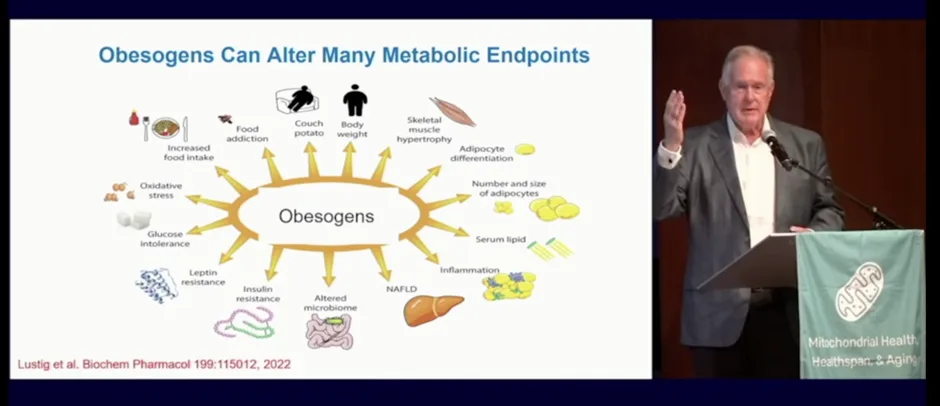
All Americans are constantly exposed to obesogens: natural (metals, viruses), anthropogenic (drugs), environmental (plastics, pesticides), or food components. Obesogens promote weight gain by altering fat metabolism. Every single obesogen generates Reactive Oxygen Species (ROS).
ROS are signaling molecules that when altered create oxidative stress where too much or too little damages cells and DNA. There are eleven mitochondrial enzymes that throw off ROS unavoidably. Mitochondria are not passive victims of ROS, as there are both good ROS and bad ROS. A byproduct of metabolism, they serve dual roles: toxic at high levels, or, signaling molecules for the body’s most critical functions, such as:
- PI3K/AKT: metabolic regulation
- NF-κB: pro-inflammatory response
- NRF2: cellular growth
- Calcium pathways: neurotransmission
ROS also signal mitochondrial ATP production to divert away from burning of energy, and toward storing it. The problem is not that ROS exist. It is that too much or too little breaks the signal either way between cellular function or damage. As shown in the image below, obesogens can alter many metabolic endpoints.
Fructose as Mitochondrial Toxin
Not all sugars behave the same way inside a cell. Glucose increases beta-oxidation, breaking down fatty acid to produce ATP. It is a built-in fuel for the body. Fructose on the other hand interferes with the machinery that makes fat burning possible.
Adding fructose to the diet inhibits mitochondria at three steps:
- AMPK: prevents biogenesis
- ACADL: blocks fatty acid cleavage
- CPT-1A: prevents fatty acid entry
Unlike glucose which increases beta-oxidation, fructose inhibits it.
Dr. Ron Kahn, Joslin Diabetes Center, shares that high fructose is bad because it makes the liver worse at burning fat, causing fat storage which alters whole body metabolism and sets into motion a cascade that begins with fatty liver disease, then moves to inflammation, and finally, progressively worsens insulin sensitivity.
Dr. Robert Lustig’s Alzheimer's hypothesis
We have spent decades framing Alzheimer’s disease as a story about proteins. Amyloid plaques build up, neurons die, and memory unravels. But what if the protein buildup is a consequence, not a cause? Remember the reductionist theory we opened with?
Imagine the real story begins far upstream, inside the mitochondria, where the brain’s energy is made.
Dr. Lustig’s hypothesis starts with the brain which consumes roughly 20 percent of the total ATP output despite it only accounting for 2% of the body weight. When mitochondria are compromised and ATP production fails, neurons do not simply slow down. They begin to fail at the most basic maintenance tasks, including processing and clearing of amyloid precursor protein (APP), which plays an important role in neural growth, maturation and neural plasticity.
Advanced glycation end products (AGEs), like environmental toxins, insulin resistance, or poor nutrition, generate ROS and are associated with cognitive decline. ROS signal mitochondria to store energy instead of burn energy. The hypothesis is that every ROS generator is associated with Alzheimer’s. Since 1956, the focus of the number of antioxidant trials have all failed.
The bottom line is when idle or compromised mitochondria reduce ATP synthesis they add stress and cortisol to cell function leading to an increase in ATP utilization, a suppression of ATP output.
Enter the new energy crisis.
When ATP falls short the consequences build on each other:
- Low ATP: increases amyloid plaque formation
- Phospho-tau: cages glycogen adding to the energy deficit
- ROS stimulates NF-κB: causing inflammation
- Plaque plus inflammation: causes neuronal death
The protein story is real. It just does not start where the research has been.
The connection between acetaminophen and autism: What Acetaminophen has to do with Mitochondria
No single exposure tells the whole story. Acetaminophen in pregnancy shows 1.05-1.2 hazard ratio for autism (5-20 percent risk increase). This is below the public health threshold of 1.3+. The signal is small because it’s not just Tylenol, it is any ROS generator. Valproate (anti-seizure drug) is a mega ROS generator and demonstrates the most established model for autism in research.
This pattern is consistent with the broader systems discussion made earlier. It is not about which single compound caused harm, but what shared upstream disruption made the developing brain vulnerable.
Evidence Behind Widespread Mitochondrial Dysfunction
The evidence that mitochondrial dysfunction is already widespread is compelling.
Let us review:
- Body temperature has declined 1.6 degrees over 150 years.
- Lab animals on identical diets have gained weight across generations.
- Newborns are being born fatter than they were 25 years ago.
These are not separate trends. They are the same signal.
The new energy crisis is mitochondrial dysfunction. The eleven mitochondrial enzymes produce the following cascade. The liver pays first and the whole body follows.
- ROS: normal products that affect ATP generation
- Obesogens: add to ROS pools
- Fructose: alters AMPK, reducing ATP
- Brain ROS: reduces production; stress increases utilization, creating crisis
- Reduced ATP: leads to plaques; inflammation causes neuronal loss
When that dysfunction reaches the brain the consequences extend across conditions.
Autism relates to mitochondrial dysfunction from any ROS source. And, the mitochondrial framework does not draw a hard line between neurological and psychiatric disease. That continuity is worth sitting with. Traditional healthcare treats each as unrelated.
Understanding neurodegeneration and mental health through mitochondrial function does not simplify the science. But it may offer a more amenable path for understanding why these conditions develop, why they so often co-occur, and how their progression might one day be interrupted at a common root.
The reductionist model keeps erring on the side of reliance of the one compound, one target, one condition model. The system’s lens asks what shared disruption made all of this possible, and where along the path can the damage be interrupted?
Watch Dr. Lustig’s full presentation by clicking the play button in the video link below.
Read / Listen Next
References
- Wojcicki, Janet M., and Melvin B. Heyman. Reducing Childhood Obesity by Eliminating 100% Fruit Juice. American Journal of Public Health 102, no. 9 (2012): 1630–1633. https://pmc.ncbi.nlm.nih.gov/articles/PMC3482038/
- Lustig, Robert H., David Collier, Christopher Kassotis, Troy A. Roepke, Min Ji Kim, Etienne Blanc, Robert Barouki, et al. Obesity I: Overview and Molecular and Biochemical Mechanisms. Biochemical Pharmacology 199 (2022): 115012. https://www.sciencedirect.com/science/article/pii/S000629522200106X
- Manczak, M. et al. (2021). Mitochondrial Dysfunction and Oxidative Stress in Alzheimer’s Disease. Frontiers in Aging Neuroscience, 13, 617588. https://doi.org/10.3389/fnagi.2021.617588
- Bondi, H. et al. (2020). Mitochondria dysfunction in the pathogenesis of Alzheimer’s disease: recent advances. Molecular Neurodegeneration, 15, 30. https://doi.org/10.1186/s13024-020-00376-6
- Yao, J. et al. (2009). Mitochondrial bioenergetic deficit precedes Alzheimer’s pathology in female mouse model of Alzheimer’s disease. PNAS, 106(34), 14670–14675. https://doi.org/10.1073/pnas.0903563106
- Bhatt, S., et al. Mitochondrial Dysfunctions in Neurodegenerative Diseases: Relevance to Alzheimer’s Disease. BioMed Research International 2014 (2014): 175062. https://doi.org/10.1155/2014/175062.
- Khaliulin, I., Hamoudi, W. & Amal, H. The multifaceted role of mitochondria in autism spectrum disorder. Mol Psychiatry 30, 629–650 (2025). https://doi.org/10.1038/s41380-024-02725-z
Additional Research for Global Mental Health Trends:
- Santomauro et al. Updated trends in the global prevalence and burden of mental disorders, 1990–2023: a systematic analysis for the Global Burden of Disease Study 2023. The Lancet, 2026. https://www.thelancet.com/journals/lancet/article/PIIS0140-6736(26)00519-2/abstract
- World Health Organization. Over a billion people living with mental health conditions – services require urgent scale-up. September 2, 2025. https://www.who.int/news/item/02-09-2025-over-a-billion-people-living-with-mental-health-conditions-services-require-urgent-scale-up
- Who Health Organization. (2023, September 16). Noncommunicable Diseases. World Health Organization. https://www.who.int/news-room/fact-sheets/detail/noncommunicable-diseases
- Santomauro et al. Service coverage for major depressive disorder: estimated rates of minimally adequate treatment for 204 countries and territories in 2021. Lancet Psychiatry, 2024. https://www.thelancet.com/journals/lanpsy/article/PIIS2215-0366(24)00317-1/fulltext