


Master your cellular energy production for peak performance, vitality, and longevity, Start the 11-part series below.

Everything that happens inside a living organism requires energy. Growth, movement, thought, speech, sleep, healing: each of these processes draws on the same fundamental resource—chemical energy—produced and managed by cells. Bioenergetics is the science of how that energy flows, how it is produced, transferred, stored, and used at the cellular level.
Understanding bioenergetics is understanding the foundation of life.
Bioenergetics is the branch of biochemistry concerned with the flow of energy through living systems. More specifically, it describes three interconnected things: how cells convert energy from food into forms they can use, how that energy is stored in chemical bonds and made available on demand, and how cells use energy to carry out every biological function from protein synthesis to immune response.
Simply put, bioenergetics describes how energy in food is converted into energy that fuels processes in cells, how that energy is used to build the molecules cells need to survive and function, and how energy is used to eliminate waste products.
At the center of the entire system is a single molecule: adenosine triphosphate, or ATP.
ATP is often called the energy currency of the cell, and the analogy is precise. Just as money does not satisfy a need directly but serves as the medium through which needs are met, ATP does not itself power a muscle contraction or a nerve impulse. It carries the energy that does.
ATP stores energy in the chemical bonds between its three phosphate groups. When the cell needs energy, an enzyme breaks one of these bonds, releasing energy and converting ATP to ADP (adenosine diphosphate). The mitochondria then use energy from food to reattach the phosphate group, regenerating ATP and making it available again.
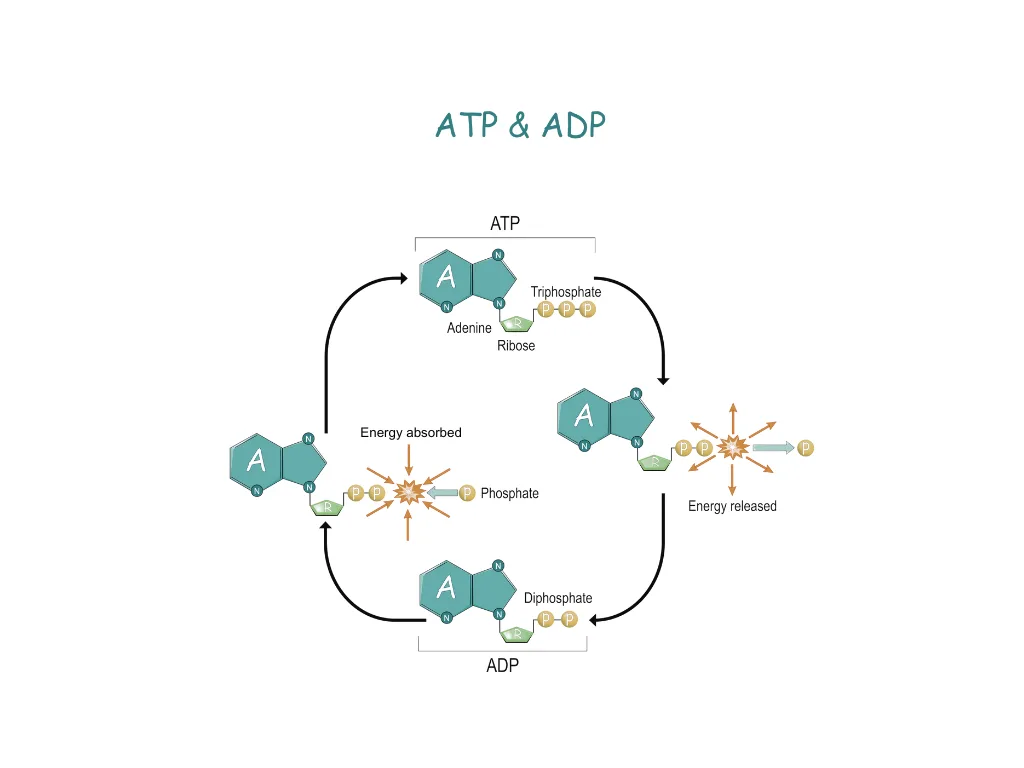
This cycle is continuous. The body does not stockpile large reserves of ATP. Instead, it regenerates what is needed constantly, using the energy extracted from nutrients. The total daily production of ATP in the human body, powered almost entirely by mitochondria, is roughly equivalent in weight to the person’s entire body mass. That extraordinary turnover happens continuously, invisibly, in every cell.
Cells extract energy from nutrients through three interconnected stages, each building on the last.
Glycolysis takes place in the cytoplasm of the cell, outside the mitochondria. It does not require oxygen. During glycolysis, one molecule of glucose is broken down into two molecules of pyruvate, producing a small net yield of ATP and generating carrier molecules that will be used in the steps that follow.
Glycolysis is fast and can operate under limited oxygen conditions, making it valuable during short bursts of intense effort. However, it is energetically inefficient relative to the full mitochondrial pathway. On its own, glycolysis extracts only a fraction of the total energy available in a glucose molecule.
The Krebs cycle does not produce large quantities of ATP directly. Its primary role is to generate the electron carriers that feed the final and most productive stage of ATP synthesis.
The electron transport chain is a series of protein complexes embedded in the inner mitochondrial membrane. The electrons extracted during glycolysis and the Krebs cycle pass through these complexes in sequence. As they move through the chain, they power the pumping of protons across the inner membrane. This creates a concentration gradient. When protons flow back through an enzyme called ATP synthase, the energy released drives the synthesis of ATP.
This process, called oxidative phosphorylation, is responsible for the vast majority of ATP produced in the cell. It requires oxygen as the final electron acceptor. Without oxygen, the chain cannot run, and the cell must rely on the far less efficient pathway of glycolysis alone.
The efficiency of the electron transport chain is central to the concept of mitochondrial health. Healthy, well-structured mitochondria with intact inner membranes and functional protein complexes produce ATP efficiently. Mitochondria with more cristae produce more ATP, and damaged or dysfunctional mitochondria produce less ATP with more oxidative waste.
While glucose is the most commonly discussed fuel, mitochondria are metabolically flexible and capable of running on multiple fuel types:
Fats. Fatty acids are imported into the mitochondrial matrix through a process called beta-oxidation, which converts them into acetyl-CoA, the same molecule that feeds the Krebs cycle from glucose metabolism. Fatty acids yield substantially more ATP per molecule than glucose, making fat an important fuel during sustained activity and periods of reduced food intake.
Amino acids. Under conditions of prolonged fasting or intense exercise, certain amino acids can be converted to metabolic intermediates and fed into the Krebs cycle, providing an additional energy substrate.
The ability to shift smoothly between these fuel sources, called metabolic flexibility, is a meaningful marker of mitochondrial health. Healthy mitochondria switch between fuels based on availability and demand. Impaired mitochondria become less flexible, often relying more heavily on glucose and burning fat less effectively.
A cell’s energy system is not static. Energy demand fluctuates constantly, responding to activity level, temperature, stress, and the cell’s metabolic state. Healthy mitochondria adjust their output to meet demand efficiently.
When this balance breaks down, the consequences are tangible. A cell that cannot meet its energy demands will curtail non-essential functions, generate stress signals, and in severe cases, initiate cell death pathways. Across a tissue or organ, widespread energy mismatch produces recognizable symptoms: fatigue, slowed recovery, impaired cognition, and metabolic inefficiency.
Bioenergetic disruption can result from multiple causes: damaged mitochondria that cannot run the electron transport chain efficiently, nutrient deficits from poor diet, excessive oxidative stress that damages the protein complexes of the chain, or accumulation of metabolic intermediates that interfere with normal pathway function.
The consequences of disrupted bioenergetics extend well beyond low energy. Impaired ATP production affects cell signaling, protein synthesis, inflammatory regulation, and the body’s capacity to repair and renew itself. These downstream effects explain why mitochondrial dysfunction is so closely linked to conditions ranging from metabolic disease to neurodegeneration.
And all the action happens in the mitochondria.
Mitochondrial health is a rich, interconnected field. The pages in this knowledge hub explore each dimension in greater depth, from the molecular mechanics of biogenesis and mitophagy to the relationship between mitochondria and specific health conditions.
Entries are numbered in order of first citation in the text. Each entry will link to the full blog post or video once its URL is supplied.
This content is for educational purposes only and is not medical advice. Consult a healthcare professional for guidance specific to your situation.
Studies, articles and talks behind this page.
“How Lyme Damages Your Mitochondria and Drives Chronic Fatigue.” BlueOakNx Blog.
Dugar, Sundeep. “Bioenergetics and Mitochondria: A Conversation with Sundeep Dugar, PhD.” BlueOakNx. YouTube video.
Dugar, Sundeep. “Energy Powerhouse: Mitochondria & More.” Interview by Dr. Rahman and Dr. Ahmad. Two Curious MDs. Podcast.
Barnett, Christopher F., Aldo Moreno-Ulloa, Sruti Shiva, Israel Ramirez-Sanchez, Pam R. Taub, Yongxuan Su, Guillermo Ceballos, Sundeep Dugar, George Schreiner, and Francisco Villarreal. “Pharmacokinetic, Partial Pharmacodynamic and Initial Safety Analysis of (−)-Epicatechin in Healthy Volunteers.” Food & Function 6, no. 3 (2015): 824–33. https://doi.org/10.1039/C4FO00596A. Free full text
October 1, 2026This content is for educational purposes only and is not medical advice. Consult a healthcare professional for guidance specific to your situation.