

Mitochondria & the Bioenergetic Threshold – Keystone of Mental Health
Over one billion persons suffer from mental health conditions such as anxiety and depression, the second largest cause of long term disability and loss of healthy life. The WHO Director-General calls for urgent prioritization to address access to care and to tackle the root causes of mental health conditions.
The connection between mitochondrial dysfunction and mental health has only been established since the 1990s, when researchers began to understand the extremely high energy demand of the brain.
This article provides a short overview of what happens with brain regulation and activities when the mitochondria become dysfunctional and do not produce enough energy.
Energy Used by the Brain
The brain is responsible for many high-energy-demand activities, ranging from memory storage and laying down new pathways, emotional regulation, critical thinking, and problem-solving to fine motor skills. Interestingly, the energy demand during REM sleep is the highest; this is when brain activity increases and the muscles are temporarily paralyzed as the brain consolidates learning, clears debris, and regulates emotions.
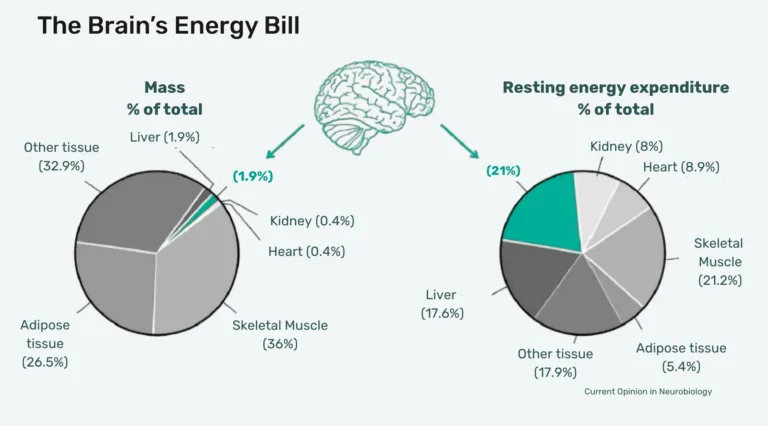
As previously discussed in a previous blog, the human brain is approximately 2% of body weight and yet uses 20% of the energy generated by the mitochondria. The image below shows the percentage weight of key organs and the corresponding energy used.
This energy currency – Adenosine Triphosphate (ATP) – powers every cellular function in the human body, including neuronal function. Each neuron in the brain contains an estimated 2 million mitochondria. Two million energy-producing factories work around the clock in every single brain cell to power everything from memory storage to emotional regulation.
Accordingly, when mitochondrial function declines, so does the brain’s ability to function optimally.
In chronic illness, mental health is often treated as a secondary symptom or a psychological reaction to physical suffering; however, emerging research into Salugenesis reveals a more fundamental truth. That is, neurotransmission is an energy-intensive process.
When the Bioenergetic Threshold is compromised by mitochondrial dysfunction, the brain’s ability to regulate sleep, impulse control, and mood is the first system to be rationed.
Understanding the Bioenergetic Threshold
The Bioenergetic Threshold refers to the critical point at which a cell’s energy demand surpasses its mitochondrial supply (reserve capacity), resulting in dysfunction.
In simpler terms, when mitochondrial energetic capacity falls below this threshold, the ensuing energy rationing contributes to the fundamental deficits and behavioral challenges associated with mental health concerns.
The Energy Cost of a Balanced Mind
The energy needed by the brain is not just for thinking; it is essential for the chemical processes of personality and stability.
For example, enzymes responsible for converting amino acids into neurotransmitters, including serotonin, are highly oxygen-dependent and metabolically demanding. Additional neurotransmitter transport throughout the brain is one of the greatest ATP consumers within neurons.
This delicate balance requires an uninterrupted supply of energy to maintain metabolic and neurochemical stability. Interruptions to this balance from exogenic assaults, such as infection, pollution, or other physiological stressors can result in the body diverting energy to the immune system.
When left unchecked, the body becomes stuck in an incomplete Cell Danger Response (CDR) Cycle.
Cell Danger Response
When the mitochondria are in Defense Mode (Cell Danger Response), ATP is diverted away from these regulatory processes. When the cell drops below its Bioenergetic Threshold, it loses the ability to maintain neurochemical stability.
The following diagram shows the three phases of CDR and the results experienced in each phase.
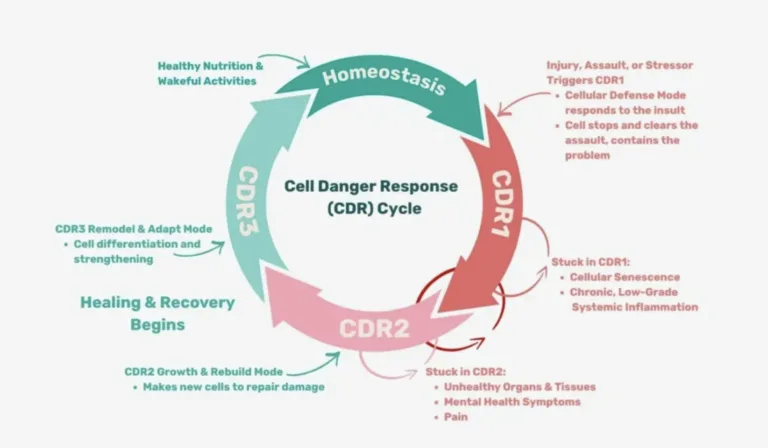
When a cell senses an assault, injury, or stressor, it engages CDR1 of the Cell Danger Response. When the body has an adequate supply of energetic resources, it moves from CDR1 to CDR2, initiating healing, growth, and recovery. It then completes the CDR Cycle by moving through CDR3.
When the Bioenergetic Threshold is reduced and lacks the energy to complete these phases, the body enters a state of dysregulation, resulting in low-grade systemic inflammation, pain, tissue degradation, and mental health symptoms.
Real-World Mental Health Indicators
Complex mental health presentations can be preceded by symptoms that are often ignored or rationalized as unimportant. These real-world indicators can be dismissed due to their lack of empirical measurement or biomarker association. While these issues may be transient, they can also be primary indicators of a greater concern.
The following three real-world indicators are significantly affected by a diminished Bioenergetic Threshold:
- Sleep quality and architecture
- Balanced mood and focus
- Impulse control
The Triad of Mitochondrial Influence
Sleep: The Metabolic Switch
Mitochondria are the secret switch for sleep. Sleep onset requires a specific metabolic shift in the ventrolateral preoptic area (VLPO).
- The Issue: Dysfunctional mitochondria fail to manage adenosine accumulation and regulate GABAergic signaling.
- The Result: Individuals experience tired but wired insomnia. They lack the cellular currency to initiate the complex, energy-demanding process of neuro-restoration that occurs during deep sleep.
Impulse Control: The Prefrontal Tax
Impulse control and executive function are localized in the Prefrontal Cortex (PFC), the brain’s most metabolically demanding region.
- The Issue: When ATP levels fall toward the Bioenergetic Threshold, the brain undergoes energy rationing. It de-prioritizes the high-cost PFC and shifts reliance to the more primitive, lower-cost limbic system (the amygdala).
- The Result: Increased irritability, poor impulse control, and brain fog. This presentation is not a lack of willpower; it is a metabolic survival strategy.
Mental Health: The Glutamate/GABA Connection
The balance between excitation (Glutamate) and inhibition (GABA) is managed within the mitochondria via the GABA Shunt.
- The Issue: Mitochondria are responsible for converting and recycling glutamate. In a state of low mitochondrial quality, glutamate accumulates in the synapse, leading to excitotoxicity and anxiety.
- The Result: A systemic shift toward anxiety, hyper-vigilance, and depression as the neurons become metabolically exhausted.
Raising the Bioenergetic Threshold - Salugenesis
To address mental health in chronic illness, one must move beyond receptor modulation (SSRI/SNRI) and address the mitochondrial bottleneck addressing the three pillars of the Mitochondrial Health Triad:
- Quantity (Biogenesis): Increasing mitochondrial density to meet the ATP demands of the Na+/K+ pumps, ensuring neurotransmitter reuptake is efficient.
- Quality (Mitophagy): Removing the leaky, dysfunctional mitochondria that produce the Reactive Oxygen Species (ROS) known to interfere with neurotransmitter synthesis.
- Function (ATP Output): Supporting cristae formation to maximize the fuel available to stay well above the Bioenergetic Threshold.
Mental health issues – anxiety, insomnia, and poor impulse control – are often lagging indications of a cellular energy crisis. If the mitochondria fail, the mind follows.
When we raise the Bioenergetic Threshold, resilience becomes the new baseline.
Read / Watch Next
- Learn more about the role of mitochondrial dysfunction in Autism Spectrum Disorders
- Watch Robert K. Naviaux, MD, PhD, Professor Emeritus, Pediatrics and Pathology, UCSD, share insights about Cell Danger Response and the emerging science of Salugenesis
- Read about the connection between dysfunctional mitochondrial, obesity, and neurodegeneration as presented by Robert Lustig, MD, MSL, Professor Emeritus of Pediatrics, Endocrinology at UCSF
- Save the Date for an educational Symposium presented by the New York Academy of Sciences and BlueOakNx on Mitochondrial Health & Healthspan: Brain Metabolism and Bioenergetics.
References
World Health Organization. Over a billion people living with mental health conditions – services require urgent scale-up. September 2, 2025. https://www.who.int/news/item/02-09-2025-over-a-billion-people-living-with-mental-health-conditions-services-require-urgent-scale-up
- Naviaux, Robert K. 2014. “The Cell Danger Response: The Metabolic Context of Chronic Disease.” Mitochondrion 16: 7–17. https://doi.org/10.1016/j.mito.2013.08.006.
- Picard, Martin, and Bruce S. McEwen. 2018. “Psychological Stress and Mitochondria: A Conceptual Framework.” Psychosomatic Medicine 80, no. 2: 126–40. https://doi.org/10.1097/PSY.0000000000000544.
- Zhao, Feng, James Slattery, and Richard E. Frye. 2017. “Mitochondrial Dysfunction and Sleep Disruption.” Journal of Clinical Medicine 6, no. 10: 94. https://doi.org/10.3390/jcm6100094.
- McCann RF, Ross DA. So Happy Together: The Storied Marriage Between Mitochondria and the Mind. Biol Psychiatry. 2018 May 1;83(9):e47-e49. doi: 10.1016/j.biopsych.2018.03.006. PMID: 29628043; PMCID: PMC6696908.